 how-to
Signs Your Guillotine Blade Needs Sharpening: 2026 Guide
Table of Contents
- How to Tell If Your Guillotine Blade Is Dull
- The Real Cost of a Dull Edge: Cut Quality and Machine Wear
- Does a Dull Blade Increase Granulator Energy Use?
- Sharpening vs. Replacement: When to Do Which
- Your Industrial Guillotine Blade Maintenance Schedule
- DIY Sharpening vs. Professional Service: A Cost-Benefit Analysis
- Troubleshooting Non-Blade Issues That Mimic a Dull Blade
- Frequently Asked Questions
Last Updated: September 14, 2026
How to Tell If Your Guillotine Blade Is Dull
A guillotine blade is dull when it tears, frays, or burns paper instead of slicing cleanly. Most operators catch it too late, after a full ream is ruined. The earliest warning signs are visual, not audible, and whether a blade can be honed or replaced depends on catching damage at the micro-chipping stage.
You don't need a lab to diagnose a dull edge, just a bright light, a clean sheet of paper, a 10x loupe, and five minutes at the clamp. Below is our inspection protocol plus the signals that reveal a failing edge before your schedule falls apart.
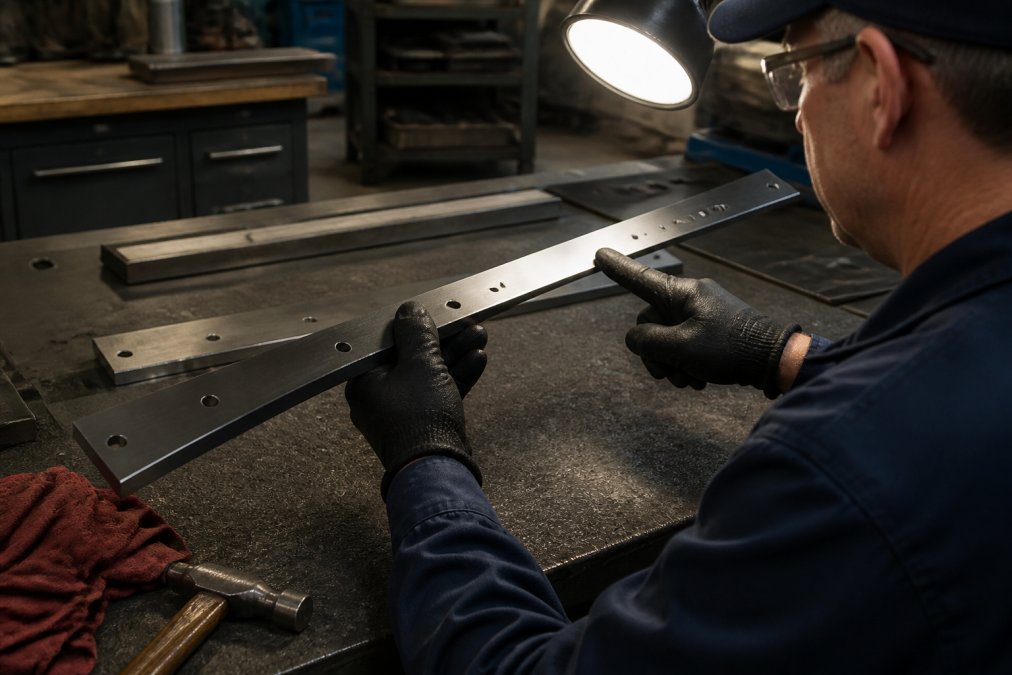
A Five-Minute Visual Inspection Checklist
Work through these steps in order. Stop at the first failure and log it.
- Lock out and tag out the machine. Never inspect a blade while the knife bar can cycle. Follow your facility's lockout/tagout procedure.
- Remove the blade and lay it on a clean, non-marring surface. A padded bench or wooden block protects the bevel during handling.
- Wipe the bevel with a lint-free cloth and light solvent. Paper dust and dried ink hide micro-chipping.
- Inspect under a bright, directional light at eye level. A healthy edge shows one continuous line of reflected light; any interruption is a nick, chip, or micro-chip.
- Magnify suspect areas at 10x. Dulling looks like a rounded, polished edge with no distinct apex; micro-chipping looks like small, irregular craters along the apex, each a few thousandths of an inch deep.
- Run a gloved fingertip along the bevel at a shallow angle, never across the apex. A burr feels like a rolled-over lip of metal; a nick feels like a catch.
- Check the bevel angle with a protractor gauge. A drift of more than a degree or two from spec is a sharpening problem, not a dulling problem.
- Log the result. Date, blade ID, measured angle, damage type, and location along the edge, the log turns a one-time inspection into a maintenance program.
Dulling vs. Micro-Chipping: Why the Distinction Matters
Dulling is gradual abrasive wear: the apex rounds, keenness drops, and cutting force rises. It is normal and reversible with a light hone or controlled grind.
Micro-chipping is discrete fracture: small pieces of the apex break away, usually from a hard inclusion, too acute a bevel angle, or lost temper from an overheated grind. It is not reversible with a hone, it requires grinding past the damaged zone, shortening blade life.
Blade metallurgy matters. High-speed steel (HSS) blades resist micro-chipping better than carbon steel because alloying elements (tungsten, molybdenum, vanadium) form hard carbides that blunt crack propagation. Carbide-tipped blades resist abrasive wear better but are more brittle: a carbide edge hitting a staple in a recycled lift will chip rather than dull. If you cut recycled stock, expect chipping to dominate and inspect for it specifically.
Performance Signs: Tearing, Fraying, and Paper Dust
Tearing and fraying at the bottom of the cut are classic dull-edge symptoms. If top sheets cut cleanly but bottom sheets tear, the blade is pushing rather than shearing, a shear force problem, not clamping pressure. Confirm with the clamp check before pulling the blade.
Paper dust is the quietest warning sign. A dull blade generates far more dust, which migrates into the cutting stick, clamp, and internal components. If the dust tray fills twice as fast as usual, inspect the blade.
Sound is the third signal. A sharp blade gives a crisp, consistent "snick"; a dull blade a lower thud; a chipped blade a rhythmic tick. Train operators to notice the change, it is often the first sign and costs nothing to monitor.
Surface finish is the fourth. Hold a trimmed edge to the light: a sharp cut is clean and slightly glossy, while a dull cut is fuzzy and fibrous with visible fiber pull-out. Coated or heavily inked stock shows ink smearing along the trim line.
The Real Cost of a Dull Edge: Cut Quality and Machine Wear
Cut quality is the visible cost of a dull edge; machine wear is the invisible one, and usually more expensive.
When a blade loses precision, the machine compensates with more clamping pressure, longer cycle times, and higher wear on the clamp cylinder, knife bar, and hydraulic system. Fraying forces reprints, reprints force overtime, and overtime eats the margin you tried to protect by stretching the blade another week.
The other cost is blade life. A dull edge that keeps running beats itself up: micro-chipping grows into full chips, chips into cracks, and a blade that could have been honed becomes scrap.
Does a Dull Blade Increase Granulator Energy Use?
Yes. A dull blade increases granulator energy use because the motor works harder to shear the same material (Advanced Search Results). A dull edge converts motor power into heat and noise instead of clean shear, and the ammeter shows it (Help).
Watch the load meter during a normal run: a sharp set draws steady current, while a dull set draws higher current, spikes more often, and pushes the motor toward its service factor. Over weeks that shows up as gearbox heat, more overload trips, and shortened motor life.
The same applies to shredder and shear blades. If your log shows rising amperage on the same material mix, inspect the blade first, not last.
Sharpening vs. Replacement: When to Do Which
Sharpen when usable bevel remains and damage is limited to the edge. Replace when the blade is ground past minimum thickness, cracks extend into the body, or the steel has lost temper. The cheaper invoice is not always the cheaper decision.
The Decision Framework
Here's a decision framework:
| Condition | Action | Why |
|---|---|---|
| Light nicks, no cracks | Sharpen (grinding or honing) | Bevel is intact; edge can be restored |
| Burrs along the full edge | Sharpen | Burrs are surface damage, not structural |
| Micro-chipping across the edge | Sharpen, then inspect bevel angle | Repeated chipping signals wrong angle or wrong steel |
| Cracks extending into the body | Replace | Crack will propagate under load |
| Blade below minimum thickness | Replace | No safe bevel left to grind |
| Overheated, blue-tinted steel | Replace | Edge retention is gone; the steel has lost temper |
Two rows deserve a closer look because operators get them wrong most often.
Minimum thickness. Every guillotine blade has a manufacturer-specified minimum thickness, usually stamped on the blade or in the manual. Sharpening removes bevel material; once minimum thickness is reached, no safe bevel remains and the blade must be replaced. Grinding past it changes stiffness, edge-holding ability, and sometimes fit in the knife bar. A sharpening service can measure thickness before every grind.
Temper loss. Blade steel is heat-treated to a specific hardness range. Grinding too aggressively on a dry wheel can draw the temper, visible as a blue or straw tint along the bevel. Once temper is lost, the steel will not hold an edge no matter how carefully it is sharpened, the most common way a DIY sharpening program destroys blades.
The Cost-Benefit Math
A sharpening invoice and a replacement invoice buy different things: sharpening buys a restored edge and a known number of remaining grind cycles; replacement buys a new blade and a full reset of that count.
Compare them by cost per cutting hour, not cost per event:
- Cost per sharpening event = sharpening fee + shipping both ways + downtime while the blade is out of the machine.
- Cost per replacement = new blade price + shipping + downtime for installation and re-alignment.
- Remaining cycles = how many more times the blade can be ground before it hits minimum thickness. A sharpening service can estimate this from the current thickness and the manufacturer's minimum.
- Cost per cutting hour = total cost of the option divided by the cutting hours it delivers before the next event.
Run those numbers and the pattern is usually clear: sharpening wins while the blade has cycles left, replacement wins once it does not. The trap is stretching a blade past its last cycle because the sharpening invoice looks cheaper, that produces a cracked blade, unplanned downtime, and an emergency replacement at whatever lead time the supplier quotes.
There is also a hidden cost on the dull-blade side: more power draw, more paper dust, faster cutting-stick wear, and increased clamp and knife-bar wear. These costs appear on no invoice until something fails, but they compound every shift.
When to Call a Sharpening Service Instead of Deciding Yourself
If you are unsure which side of the line you are on, a sharpening service can measure blade thickness and bevel angle. That measurement can be more cost-effective than guessing wrong either way, and it can produce a documented blade history for forecasting replacements.
Your Industrial Guillotine Blade Maintenance Schedule
An industrial guillotine blade maintenance schedule is a written plan tying inspection, rotation, sharpening, and replacement to actual production volume, not a calendar guess. A three-shift shop on coated stock needs a very different cadence than a one-shift shop cutting uncoated text.
A practical baseline:
- Daily: Visual inspection of the cutting edge under light; listen for changes in cut sound.
- Weekly: Check cutting stick for grooves; verify clamping pressure is consistent across the lift.
- Monthly: Measure blade wear; log ammeter readings on granulators and shears.
- Quarterly: Full blade inspection with a sharpening service; rotate or replace as needed.
- Annually: Review blade life data and adjust the schedule based on actual hours.
The schedule only works if someone owns it. Assign the log to a named maintenance supervisor and review it monthly.
DIY Sharpening vs. Professional Service: A Cost-Benefit Analysis
DIY sharpening works with the right equipment, training, and blade geometry reference. It fails when any of the three is missing, usually quietly, by shortening blade life rather than destroying the blade outright.
The honest trade-off:
- DIY pros: Lower per-event cost, faster turnaround, no shipping.
- DIY cons: Bevel angle drift, heat damage from improper grinding, no thickness measurement, no warranty.
- Professional pros: Correct bevel angle, controlled heat, thickness verification, documented blade life.
- Professional cons: Shipping time, scheduling, per-event cost.
For guillotine blades, shear blades, and press brake punches, the bevel angle is not negotiable. Grind it wrong and the blade chips again within days, the failure mode most in-house programs hit. Professional sharpening can restore original geometry, which can extend blade life.
Troubleshooting Non-Blade Issues That Mimic a Dull Blade
Not every bad cut is a blade problem. Before pulling the blade, rule out the four issues that most often mimic a dull edge.
Clamping pressure. If the clamp doesn't hold the lift firmly, sheets shift and tear at the bottom even with a sharp blade. Check the clamp cylinder and pressure setting.
Cutting stick condition. A grooved or worn stick lets the blade bottom out unevenly, fraying the last sheets of every lift. Rotate or replace on schedule.
Blade alignment and blade gap. If the blade is not square to the table or the gap is out of spec, the cut will be ragged regardless of edge condition. Verify alignment after every blade change.
Back gauge accuracy. A drifting back gauge produces inconsistent cut sizes operators misread as a dull blade. Measure a test cut with calipers before blaming the edge.
If all four check out and the cut is still bad, the blade is the problem. Send it out.
A dull guillotine blade costs more than a sharpening invoice, it costs cut quality, machine wear, energy, and operator time, compounding every shift you run it. The Cutting Edge Grinding & Supply Co. has spent over two decades restoring guillotine blades, shear blades, granulator knives, and press brake punches to correct geometry, with precision sharpening services and a full catalog of new machine knives and accessories across printing, converting, metalworking, and plastics. Get started with The Cutting Edge Grinding & Supply Co. and put a documented maintenance schedule behind every blade in your shop.
Frequently Asked Questions
How can you tell if a guillotine blade is dull?
Look for physical and performance signs. Physically, inspect the cutting edge for nicks, chips, or a shiny, rounded edge instead of a sharp bevel. In operation, a dull guillotine blade will tear or fray paper instead of cutting it cleanly, produce excessive paper dust, and require more clamping pressure to hold the stack. You might also notice the cut edge is no longer square or smooth.
How often should industrial guillotine blades be sharpened?
There is no single schedule. The frequency depends on the material being cut, daily volume, and the blade steel. A high-production printing shop might need to sharpen a guillotine blade every few weeks, while a lighter user might go months. The most reliable approach is to follow an industrial guillotine blade maintenance schedule based on your specific usage and inspect the blade regularly for signs of wear.
Can a dull blade damage the guillotine machine?
Yes. A dull blade requires more force to cut, which puts extra stress on the machine's hydraulic system, clamping mechanism, and blade carriage. Over time, this can lead to premature mechanical wear and costly repairs. Additionally, the increased friction can cause the blade to heat up and warp, leading to alignment issues. Keeping the blade sharp is key to reducing machine wear.
What is the difference between honing and sharpening a guillotine blade?
Honing is a maintenance technique that realigns the existing cutting edge, removing minor burrs and restoring sharpness without removing much material. It is done frequently with a honing tool. Sharpening, or grinding, is a more aggressive process that removes a significant amount of material to create a new bevel and cutting edge. Sharpening is required when the blade is severely dull or has nicks and chips.