 how-to
5 Steps to Reduce Machine Downtime Costs
Last Updated: October 24, 2026
Quick Summary
To reduce machine downtime costs, calculate what downtime actually costs your operation, track failures systematically to find patterns, implement preventive maintenance before failures occur, perform root cause analysis on recurring problems, and measure results using standard reliability metrics like MTBF and availability.
- Downtime cost has five components: lost output, idle labor, scrap and rework, restart costs, and penalties or expediting charges.
- A mid-size converting line that experiences a 3.5-hour blade failure incurs approximately $5,795 in total costs across all five categories.
- Preventive maintenance scheduled before failure occurs costs less than emergency repairs and prevents far larger downtime expenses.
- Track four core metrics: MTTR, MTBF, availability, and cost per downtime hour to validate whether prevention efforts are working.
- Establish a 60-90 day baseline before implementing changes so you can measure improvement and calculate ROI defensibly.
Table of Contents
- Understanding Machine Downtime and Its Financial Impact
- Identifying Unplanned Downtime Causes in Your Operation
- Step 1: Calculate Your Manufacturing Downtime Cost
- Step 2: Track Equipment Downtime to Find Patterns
- Step 3: Implement Preventive Maintenance for Manufacturing Equipment
- Step 4: Perform Root Cause Analysis on Recurring Failures
- Step 5: Measure Results and Validate Your Cost Reduction
- Getting Started with Blade Maintenance and Sharpening Services
- Frequently Asked Questions
Understanding Machine Downtime and Its Financial Impact
Machine downtime happens when equipment stops running unexpectedly or is taken offline for maintenance. For production managers and maintenance supervisors, unplanned downtime creates immediate pressure: production halts, deadlines slip, and costs climb fast.
The difference between planned and unplanned downtime matters enormously. Planned downtime is scheduled maintenance you control. Unplanned downtime is the breakdown that catches you off guard. Both cost money, but unplanned downtime carries hidden expenses that planned maintenance doesn't.
We see the same pattern repeatedly: businesses treat downtime as an unavoidable cost rather than a problem to solve. That mindset leaves thousands of dollars on the table each year.
This guide walks you through five concrete steps to reduce machine downtime costs in your operation. You'll learn how to calculate what downtime actually costs, track it systematically, prevent failures before they occur, and measure the financial return on your prevention efforts.
Identifying Unplanned Downtime Causes in Your Operation
Most equipment failures follow patterns. A blade wears unevenly because feed pressure is misaligned. A motor fails because vibration goes unchecked. A shear blade breaks because material hardness wasn't adjusted for. These aren't random events, they're symptoms of conditions you can monitor and correct.
The first step toward reducing downtime is understanding what breaks your equipment and why. Common causes include:
- Dull or damaged blades that force equipment to work harder
- Misalignment in feed systems or blade holders
- Inadequate lubrication or cooling
- Operator error or improper material handling
- Lack of preventive maintenance schedules
- Worn bearings, belts, or drive components
- Contamination in hydraulic or pneumatic systems
Each cause creates a different financial impact. A dull blade might slow production by 15 percent. A complete blade failure might shut down a line for hours. Identifying which failures happen most often in your operation tells you where to focus your prevention efforts first.
Step 1: Calculate Your Manufacturing Downtime Cost
You can't manage what you don't measure, and most facilities have never calculated what an hour of downtime actually costs.
A credible downtime cost estimate separates five components. Build each one for the specific asset, then add them.
**1.
**2.
3. Scrap and rework. Downtime often produces a burst of defective product at restart.
4. Restart and changeover cost. Warm-up cycles, purging, recalibration, and lost first-off inspection consume time and material.
5. Penalties and expediting. Late-delivery chargebacks, expedited freight, overtime to recover schedule, and customer credits.
Worked example. A mid-size converting line produces 1,200 units per hour at a $0.90 contribution margin.
Formula. Total downtime cost = (lost output + idle labor + scrap/rework + restart cost + penalties/expediting) × number of events.
Document the calculation for each critical asset. You will use it in Step 5 to prove return on investment, and you will use it immediately to rank which failures deserve attention first.
Step 2: Track Equipment Downtime to Find Patterns
Tracking downtime systematically reveals which equipment fails most often and when. Without this data, you're guessing about where to invest prevention effort.
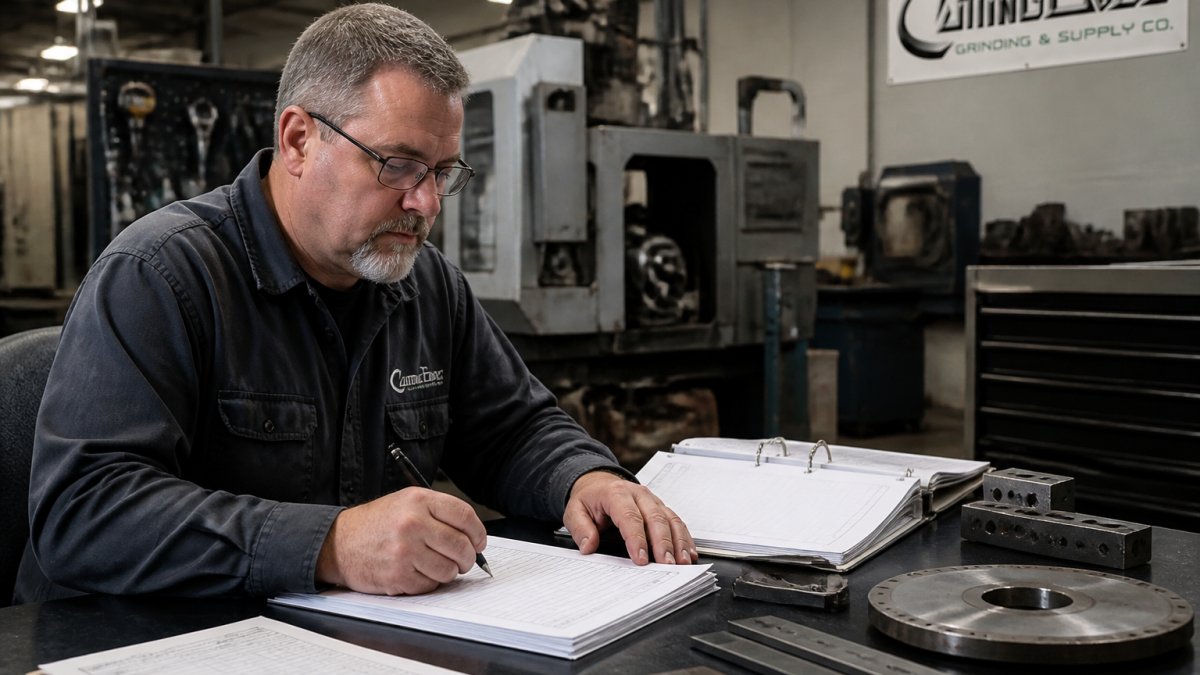
Start with the basics. For each downtime event, record:
- Equipment name and ID
- Date and time downtime began
- Duration in minutes or hours
- Root cause (if known)
- Repair action taken
- Who performed the repair
Use a simple spreadsheet or maintenance software. The format matters less than consistency. After 30 days of tracking, patterns emerge.
Understanding common causes of machine knife wear helps you interpret your data. A blade that fails every 40 hours might indicate misalignment.
The Industrial Blade Maintenance Checklist 2026 provides a framework for tracking maintenance intervals alongside downtime events. Cross-referencing them shows whether downtime correlates with skipped maintenance or whether maintenance intervals need adjustment.
Step 3: Implement Preventive Maintenance for Manufacturing Equipment
Preventive maintenance stops failures before they happen. It's the most cost-effective downtime reduction strategy available.
Preventive maintenance for manufacturing equipment typically includes:
- Regular blade sharpening or replacement on schedule
- Inspection of alignment and mounting hardware
- Lubrication and cooling system maintenance
- Vibration and temperature monitoring
- Operator training on material handling and speed settings
The key is scheduling maintenance before failure, not after. If your data shows that a blade typically fails after 180 hours of use, schedule sharpening at 150 hours.
Preventive maintenance costs money upfront. A sharpening service costs less than an emergency repair, but both cost something. The math works because preventing one unplanned failure saves far more than the maintenance cost itself.
The Cutting Edge Grinding & Supply Co. works with production managers to build maintenance schedules tailored to specific equipment and usage patterns. Professional sharpening services restore blades to peak performance and extend their lifespan, reducing both downtime and replacement costs.
Step 4: Perform Root Cause Analysis on Recurring Failures
When the same equipment fails repeatedly despite preventive maintenance, root cause analysis finds the underlying problem.
A recurring failure means your prevention strategy isn't addressing the real issue. A blade that keeps breaking despite regular sharpening might indicate:
- Misalignment in the blade holder or feed system
- Material hardness changing between batches
- Operator speed settings too aggressive
- Cooling or lubrication system failure
- Defective replacement parts
Root cause analysis requires investigation. Check alignment with precision tools. Review material specifications and batch records. Interview operators about changes in speed, material, or procedure. Examine failed blades for clues: are breaks clean or jagged?
Once you identify the root cause, fix it directly. If misalignment is the problem, adjust and verify with measurements. If material hardness changed, adjust speed or blade material. If operator technique is wrong, retrain and monitor.
The difference between treating symptoms and treating causes determines whether downtime stays high or drops permanently.
Step 5: Measure Results and Validate Your Cost Reduction
Prevention spending is only justified when the numbers move. This step turns your downtime log into a before-and-after case that survives a budget review.
Establish a baseline first. Before changing anything, record 60-90 days of data on the assets you plan to address.
Track the four core metrics. These are standard reliability measures and are widely used across manufacturing:
- MTTR (mean time to repair) = total repair hours ÷ number of repairs. Falling MTTR means your team responds and restores faster, often through spare-parts readiness and clearer repair procedures.
- MTBF (mean time between failures) = total operating hours ÷ number of failures. Rising MTBF means failures are genuinely less frequent, not just shorter.
- Availability = operating time ÷ (operating time + downtime). Report it per asset and per line; a line is only as available as its bottleneck.
- Cost per downtime hour = total downtime cost ÷ total downtime hours. This is the number that makes the case to leadership because it is directly comparable to the cost of prevention.
Separate frequency from duration. Frequency improvements show up in MTBF and event counts; duration improvements show up in MTTR.
Validate with a control asset. If possible, leave one comparable asset on the old practice for the same period.
Document results and share them with the team and leadership. Visible wins build momentum for the next improvement, and a repeatable measurement method means each subsequent investment is easier to justify than the last.
Track these four standard reliability metrics to measure whether your downtime reduction efforts are working.
| Metric | Calculation | What It Shows |
|---|---|---|
| MTTR | Total repair hours ÷ number of repairs | How fast your team responds and restores |
| MTBF | Total operating hours ÷ number of failures | Whether failures are genuinely less frequent |
| Availability | Operating time ÷ (operating time + downtime) | Percentage of time equipment is ready to run |
| Cost per downtime hour | Total downtime cost ÷ total downtime hours | Direct comparison to prevention investment cost |
Getting Started with Blade Maintenance and Sharpening Services
Reducing downtime costs starts with a single decision: to measure, prevent, and improve systematically. The steps in this guide provide the framework. Implementation requires choosing partners who understand your equipment and can deliver reliable service.
Professional blade sharpening is often the fastest way to reduce downtime. How to Compare Blade Sharpening Providers helps you evaluate options and select a partner aligned with your reliability goals. Dull blades force equipment to work harder, wear faster, and fail sooner.
The Cutting Edge Grinding & Supply Co. brings over two decades of experience restoring blades to peak performance across printing, converting, metalworking, and plastics industries. We understand the specific demands of your equipment and the precision required to eliminate downtime caused by blade condition. Sharpening Services provides fast turnaround and consistent quality, so your equipment stays running and your production stays on schedule.
Start by calculating your current downtime cost. Track it for one month. Then implement one preventive maintenance improvement, typically professional blade sharpening, and measure the impact. From there, systematic improvement compounds. Prevention becomes the norm, downtime becomes rare, and costs fall predictably.
Frequently Asked Questions
What does equipment downtime actually cost a manufacturing operation?
Equipment downtime costs vary widely by industry and asset type. Direct costs include lost production revenue and labor wages during repairs. Indirect costs, expedited shipping for parts, delayed customer orders, and rework, often exceed direct costs. A single hour of production line downtime at a printing or metalworking shop can cost hundreds to thousands of dollars depending on throughput and customer penalties. The only way to know your true cost is to calculate it using your actual production capacity, labor rates, and material costs.
How do I calculate the cost of machine downtime for my shop?
Start with three numbers: hourly production capacity (units per hour), profit margin per unit, and fully loaded labor cost per hour. Multiply capacity by margin to get lost revenue per hour. Add labor costs for repairs and any expedited shipping or overtime. For a guillotine or shear blade failure, include setup time to install a replacement or send blades out for sharpening. Document actual downtime incidents over one month to establish a baseline, then multiply by 12 to project annual impact. This real number drives investment decisions in preventive maintenance and blade quality.
What are the most common causes of unplanned downtime in printing and metalworking shops?
Dull or damaged cutting blades are among the leading causes, guillotine blades, shear blades, and granulator knives lose their edge under continuous use, forcing stops for replacement or sharpening. Lack of preventive maintenance schedules means equipment runs until it fails. Poor root cause analysis after breakdowns means the same failure repeats. Supply chain delays for spare parts extend downtime. Operator error and inadequate training also contribute. Tracking which failures repeat most often reveals which issues deserve immediate investment in prevention.
How can preventive maintenance reduce equipment downtime in a manufacturing setting?
Preventive maintenance stops problems before they cause production stops. Regular blade sharpening or replacement on a schedule, rather than waiting for failure, keeps cutting quality consistent and reduces sudden breakdowns. Planned maintenance windows (scheduled during low-demand periods) replace emergency repairs that disrupt customer orders. Condition monitoring catches wear early, so you can order replacement parts in advance instead of paying expedited fees. A preventive maintenance program costs less than unplanned downtime because you control the timing, reduce labor urgency, and avoid the cascading costs of missed deadlines and customer dissatisfaction.
The path to lower downtime costs is straightforward: measure precisely, prevent systematically, and improve continuously. Equipment reliability isn't luck, it's the result of eliminating the conditions that cause failure. Get started with The Cutting Edge Grinding & Supply Co. and transform downtime from a chronic cost drain into a controlled, preventable expense. SHOP NOW