 how-to
How to Extend Granulator Blade Life: 7 Proven Steps
Table of Contents
- Why Extending Granulator Blade Life Matters
- Does Dull Blade Increase Granulator Energy Consumption
- Step 1: Establish a Routine Maintenance Schedule
- Step 2: Inspect Blades for Signs of Wear
- Step 3: Master Granulator Knife Gap Adjustment Guide
- Step 4: Control Feed Rate to Reduce Wear
- Step 5: Implement Blade Rotation for Even Wear Distribution
- Step 6: Choose Between Precision Sharpening and Replacement
- Frequently Asked Questions
Last Updated: September 18, 2026
Why Extending Granulator Blade Life Matters
Dull granulator blades slow production, waste energy, and force premature replacement. A blade that should last six months might wear out in two or three without proper maintenance.
Most operations lack a system to catch wear early, running until failure forces emergency replacement and costly downtime.
We've worked with production managers who discovered they could extend granulator blade life significantly through straightforward preventative practices instead of reactive replacement.
This guide covers seven proven steps to extend granulator blade life: spotting wear early, proper equipment adjustment, and deciding between sharpening and replacement.
Does Dull Blade Increase Granulator Energy Consumption
Dull blades increase energy consumption significantly. The motor works harder to push material through, pulling more current and raising electrical costs.
Sharp blades slice cleanly with minimal resistance; dull blades crush and tear, generating friction and heat that forces the motor to work harder and accelerates degradation.
As blades dull, feed rate drops and motor load increases, less output with more energy consumption.
Quantifying the Energy Cost of Dull Blades
A typical plastic granulator motor draws 15-30 amps at full load when sharp. As blades dull over four months, motor draw increases 20-35 percent, an additional 4-7 amps on a 20-amp baseline.
At an average industrial electricity rate of $0.12 per kilowatt-hour and assuming 40 hours per week of operation:
- Sharp blades: 20 amps × 480 volts × 0.8 power factor = 7.68 kW
- Dull blades (30% increase): 10 kW
- Weekly energy cost increase: (10 − 7.68 kW) × 40 hours × $0.12 = $11.14 per week
- Annual cost of running dull blades: $580 per year (on a single granulator)
For operations running multiple granulators or 24/7 schedules, this multiplies quickly. A facility with five granulators running dull blades could waste $2,900 annually in excess electricity alone.
Material-Specific Energy Penalties
Harder, abrasive materials (carbon-filled nylon, glass-reinforced polycarbonate) cause faster dulling and steeper energy increases. Softer materials like LDPE show gradual energy creep.
PET regrind exhibits 25-30 percent motor load increase by month three of a four-month cycle; HDPE shows 15-20 percent; nylon compounds can reach 40 percent or more with contamination.
The Sharpening ROI Window
Precision sharpening can offer a rapid return on investment. The key is timing: sharpen blades before they reach the steep part of the energy-cost curve (usually around month 2.5-3 of a four-month cycle), not when they're nearly worn out. Early intervention captures the most energy savings.
The key is timing: sharpen blades before they reach the steep part of the energy-cost curve (usually around month 2.5-3 of a four-month cycle), not when they're nearly worn out. Early intervention captures the most energy savings.
Monitoring Motor Load as a Maintenance Trigger
If your granulator has a motor load gauge or ammeter, use it. Record baseline amperage when blades are freshly sharpened or new. Set a threshold, typically 20-25 percent above baseline, as your signal to sharpen or replace. This data-driven approach removes guesswork and prevents the worst energy waste.
Many modern granulators log motor data digitally. If yours does, export that data monthly. A rising trend in average amperage over weeks is a clearer maintenance signal than visual inspection alone.
Step 1: Establish a Routine Maintenance Schedule
A maintenance schedule catches problems before they become expensive.
Document baseline blade life for your material and conditions, typically three to six months for standard plastic regrind, depending on material type and feed rate.
Schedule inspections at the halfway point of your baseline cycle to plan ahead instead of reacting to failure.
Setting Up Your Maintenance Log
Track inspection date, blade condition, adjustments, feed rate, motor load, and sharpening/replacement dates in a simple spreadsheet. This reveals patterns, faster-than-expected wear signals contamination, feed rate changes, or knife gap drift.
Review monthly to identify maintenance windows and schedule sharpening during slow periods.
Step 2: Inspect Blades for Signs of Wear
Visual inspection catches wear before it becomes critical.
Sharp blades have clean, defined edges; worn blades show rounded or chipped edges; dull blades show scratches or heat discoloration.
Look for rounded edges (worn smooth but still cutting), chips or nicks (uneven cutting, accelerated damage), discoloration (heat stress), and uneven wear (knife gap or alignment problem).
Feel the blade edge (after powering off and locking out): sharp blades feel crisp, dull blades feel rounded.
Embedded particles or scoring indicate contamination requiring pre-processing screening.
Step 3: Master Granulator Knife Gap Adjustment Guide
Knife gap (blade clearance) is the space between opposing blades. Incorrect gaps cause uneven, rapid wear.
Too tight causes friction and heat; too loose causes poor cutting and harder work. Ideal gap is typically 0.005-0.015 inches depending on model and material.
Check your manual for recommended clearance. Most granulators have adjustment bolts on the blade housing for fine-tuning.
Using a Blade Clearance Gauge
Power down and lock out. Insert the clearance gauge between blades at top, middle, and bottom. Adjust housing bolts gradually, a quarter-turn typically changes gap by 0.002 inches. Recheck after each adjustment.
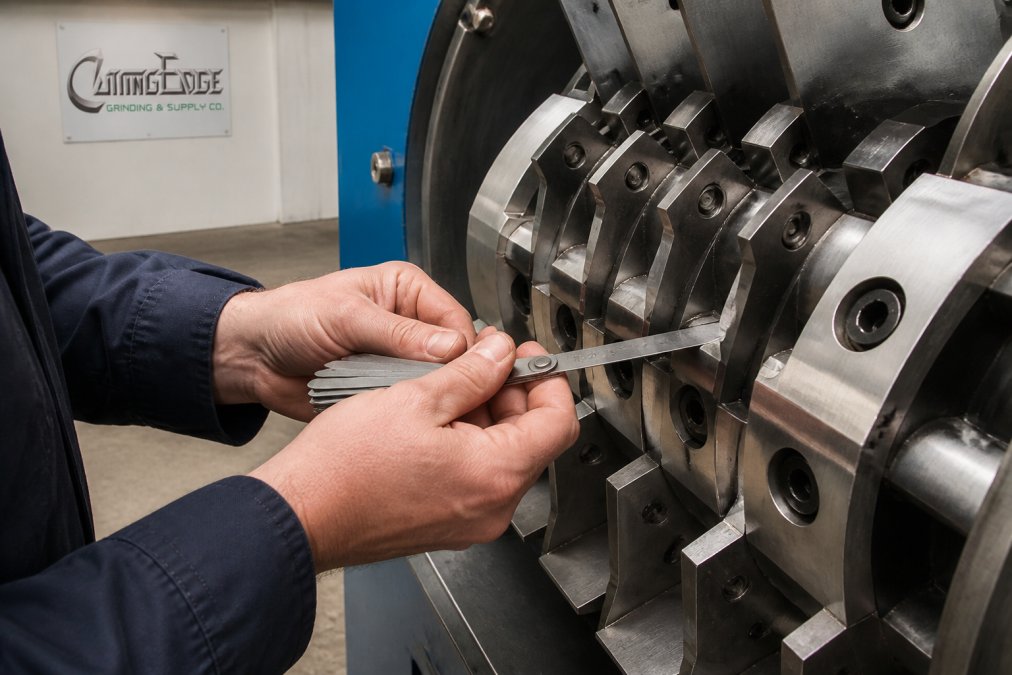
Uneven gaps indicate misalignment or warping, requiring professional service.
Step 4: Control Feed Rate to Reduce Wear
Feed rate directly impacts blade stress: higher rates mean more material hitting blades and more wear.
Softer materials tolerate faster feed rates; harder or contaminated materials need slower speeds.
Reduce feed rate 10-15 percent and monitor motor load, cut quality, and jamming. If all improve, run at this rate for weeks and track blade wear, slower rates often extend life by months.
Lower throughput is offset by less frequent blade replacement and reduced downtime.
Document your optimal feed rate in your maintenance log. This becomes your baseline for future adjustments.
Step 5: Implement Blade Rotation for Even Wear Distribution
Rotating blades periodically ensures even wear distribution across the set.
Mark blades with paint or numbers. Rotate monthly or every other month depending on wear rate.
Rotate blades systematically (top → middle → bottom → top) to spread wear and extend the interval before replacement.
Rotation reveals position-specific wear patterns, signaling knife gap, alignment, or feed distribution problems.
Step 6: Choose Between Precision Sharpening and Replacement
Blades eventually need sharpening or replacement. The right choice depends on blade condition, material type, cost, and production timeline.
Sharpening restores near-original sharpness; replacement means buying new blades.
Understanding Blade Material and Wear Limits
Blade material determines sharpening limits. Most industrial granulator blades use various alloys, each with different sharpening limits. Check your manual or supplier to know your blade material, this determines sharpening budget and replacement timeline.
Check your manual or supplier to know your blade material, this determines sharpening budget and replacement timeline.
Material-Specific Wear Patterns and Sharpening Viability
Different materials wear blades differently. Understanding these patterns helps you decide between sharpening and replacement.
PET regrind: Moderate, even wear. Sharpening effective. Window: months 2-3 of 4-month cycle. Replace after 3-4 sharpenings.
HDPE regrind: Slower wear, minimal chipping. Sharpening extends life significantly. Window: months 3-4 of 5-month cycle.
Decision Framework: Sharpening vs. Replacement
Sharpen when: Blades show wear without visible chips or thermal discoloration; still cut with noticeable resistance; processing softer materials with even wear; have 3-5 days for service; fewer than 3-4 prior sharpenings; motor load increased 15-25 percent.
Cost-Benefit Calculation
Track sharpening vs. replacement costs in a simple spreadsheet:
Example: HSS blade set (4 blades) in a PET regrind operation
- New blade set cost: $80 (4 × $20)
- Sharpening cost per cycle: $48 (4 × $12)
- Energy savings per sharpening cycle: $150-$200 (from reduced motor load)
- Downtime cost per blade replacement: $500-$1,500 (lost production during changeover)
- Downtime cost per sharpening: $50-$100 (blades out for 2-3 days)
Frequently Asked Questions
Does a dull granulator blade increase energy consumption?
Yes. Dull blades force the motor to work harder to cut material, increasing energy draw and motor load. This raises operational costs and accelerates wear on other machine components. Sharp blades reduce shear force requirements, lowering energy consumption by up to 15-20% depending on material type and machine condition. Regular sharpening or timely replacement maintains efficiency.
How often should granulator blades be sharpened?
Sharpening frequency depends on material type, feed rate, and blade quality. Plastic regrind typically requires sharpening every 40-60 operating hours, while virgin material may extend to 80-120 hours. Inspect blades weekly for dull edges and thermal degradation. Monitor motor load and throughput efficiency, rising energy consumption signals blade dulling. Keep a maintenance log to track intervals specific to your operation.
What are the signs that granulator blades need replacement?
Replace blades when precision sharpening no longer restores cutting performance, when impact resistance has diminished, or when blade geometry is damaged beyond repair. Visual inspection should reveal chips, cracks, or uneven wear patterns. If blades have been sharpened multiple times and performance continues declining, replacement becomes more cost-effective than continued regrinding. Material-specific wear patterns vary, plastic regrind may show fines accumulation, while harder materials cause thermal degradation.
What is the correct knife gap setting for a granulator?
Correct knife gap varies by material and blade type but typically ranges from 0.005 to 0.015 inches. Use a blade clearance gauge for precise measurement. Improper clearance causes uneven wear, increased motor load, and poor regrind quality. Too tight a gap creates friction and thermal stress; too loose allows material slip and inconsistent particle size. Consult your machine manual for exact specifications, and check clearance monthly as part of preventative maintenance.