 ultimate-guide
How Long Do Guillotine Blades Last in High-Volume Shops?
Last Updated: November 4, 2026
Quick Summary
Guillotine blades in high-volume shops typically last between 8 and 160 hours of operation, depending mainly on steel type. Standard steel lasts about 8 hours, HSS about 16 hours, and carbide up to 160 hours. Most high-volume shops inspect and replace blades every one to three months.
- Standard steel guillotine blades need replacement or sharpening after about 8 hours of operation.
- HSS inlaid blades last roughly twice as long, around 16 hours.
- Carbide blades can last up to 160 hours before replacement.
- Track blade life by cuts or lift cycles, since idle time does not wear the edge.
- High-volume shops are generally advised to inspect and replace blades every one to three months.
Table of Contents
- Typical Guillotine Blade Lifespan by Steel Type
- Signs of a Dull Paper Cutter Blade
- How Often Guillotine Blade Sharpening Frequency Should Be Scheduled
- How Workload, Paper Stock and Clamp Pressure Change Blade Wear
- D2 vs HSS Guillotine Blades: Which Steel Fits Your Shop
- Sharpen or Replace: A Decision Framework and Blade-Life Tracking
- Booking Your Next Blade Service With The Cutting Edge
- Frequently Asked Questions
Typical Guillotine Blade Lifespan by Steel Type
Guillotine blades in high-volume shops typically last between 8 and 160 hours of operation, depending mainly on the steel they are made from. Standard steel knife blades need replacement or sharpening after about 8 hours of operation, while high-speed steel (HSS) inlaid blades last roughly twice as long, around 16 hours Lifespan benchmarks for guillotine paper cutters. Carbide blades stretch the range furthest, lasting up to 160 hours before replacement Comparison of blade material durability.
A shop that runs a single shift of light cutting and a shop that runs three shifts on coated stock can both use the same steel and still see blade life differ substantially. The more reliable way to plan is to track blade life in a unit your shop already records: cuts, sheets, or lift cycles.
Translating Hours Into Cuts and Sheets
A guillotine blade does not wear by the clock; it wears by the cut. Every clamp-down and knife stroke abrades a small amount of edge, and the number of strokes is what accumulates.
To build your own estimate, record how many cuts a blade completes between sharpenings on your machine, then express that life in the same unit as your job tickets.
Sheets per lift matter as much as cuts. A shop cutting 500-sheet lifts puts far more paper under the knife per stroke than a shop cutting 100-sheet lifts, so the same cut count represents very different wear. Record both the number of cuts and the average lift height, and you will see why two shops with identical steel can report very different lifespans.
Lifespan Ranges by Workload
Rather than a single number, plan against a range that reflects how hard the machine is worked. The table below pairs the steel benchmarks with the workload profile that typically produces them. These ranges are practical planning bands, not guarantees.
| Blade material | Light, occasional cutting | Moderate, regular production | Heavy, high-volume runs |
|---|---|---|---|
| Standard steel | Toward the low end of the 8-hour benchmark; often several weeks between sharpenings | Near the 8-hour benchmark per sharpening cycle | Reaches the benchmark quickly; frequent changeovers |
| HSS inlaid | Well beyond the 16-hour benchmark per cycle | Near the 16-hour benchmark | At or below the benchmark; plan for scheduled swaps |
| Carbide | Long intervals between service | Extended intervals | Approaches the 160-hour upper bound only under favorable stock and setup |
The pattern to watch is the direction of travel. If your HSS blades used to reach the 16-hour benchmark and now fall short of it on the same jobs, something in the stock, the clamp, or the cutting stick has changed. That shift is more informative than the absolute number.
Why Hardness Matters: The 55-65 HRC Range
Modern guillotine blades are typically designed to operate within a hardness range of 55 to 65 HRC Technical specifications for industrial blades. Harder blades hold an edge longer, but they give up some toughness, which makes them more prone to chipping if they meet a staple or a warped clamp. Manufacturers balance these two properties, and the right point on that scale depends on your paper stock and your cutting volume.
Steel choice is the first decision that shapes blade life, but the cut log is the second. Actual service life depends on how hard the machine is worked and how consistently you record the work.
Signs of a Dull Paper Cutter Blade
A dull blade shows itself in the cut long before it fails outright. Ragged or fuzzy edges on stacked sheets, slightly tapered cuts, and a visible increase in the force needed to close the clamp are the most common warning signs. Watch the cut quality on every job rather than waiting for a total failure.
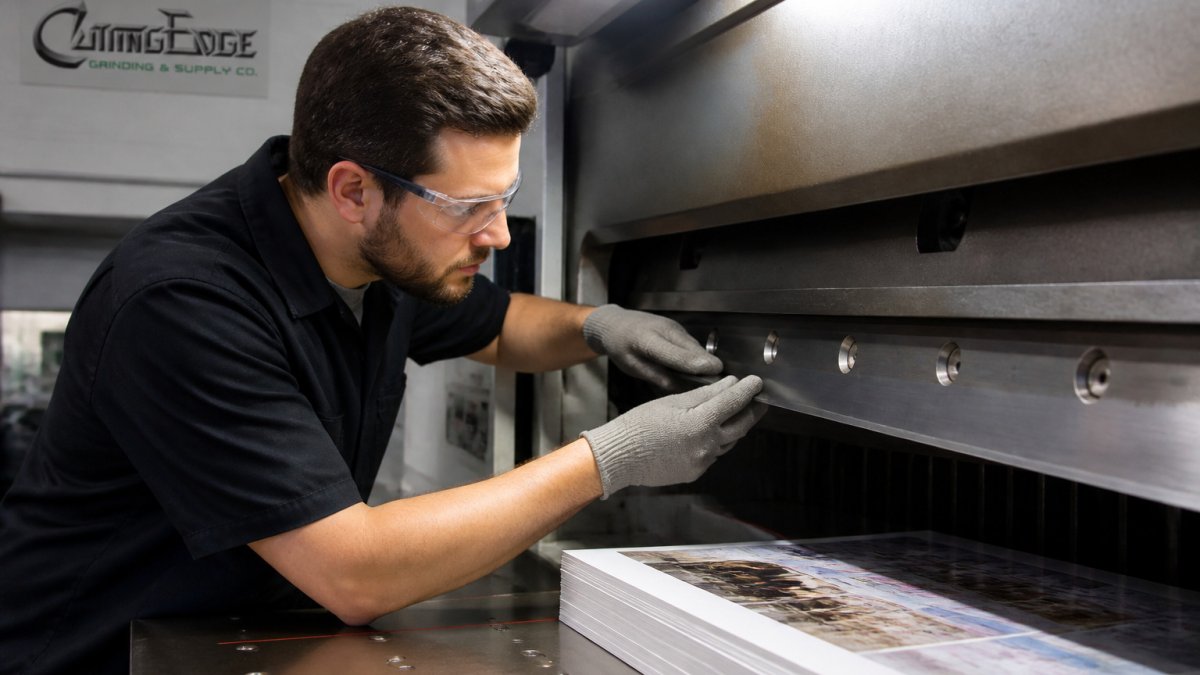
Dust and paper residue building up along the cutting line can also signal a blade that is no longer clean and sharp. In high-volume work, catching these signs early avoids scrap, rework and unplanned downtime.
How Often Guillotine Blade Sharpening Frequency Should Be Scheduled
High-volume print shops are generally advised to inspect and replace guillotine blades every one to three months to maintain cutting quality Maintenance intervals for high-volume environments. That interval is a starting point, not a fixed rule. Shops running heavy stock or continuous shifts will reach the low end of the range, while lighter operations can stretch it.
Set your sharpening frequency against your own cut logs. Record the number of cuts or hours between sharpenings, note when quality starts slipping, and adjust the schedule from that data.
How Workload, Paper Stock and Clamp Pressure Change Blade Wear
Three factors drive most of the difference in blade life between shops: how much you cut, what you cut, and how the clamp is set. Heavy daily volume shortens life directly. Abrasive or coated stock wears an edge faster than uncoated paper. Excessive clamp pressure can deform the edge and accelerate chipping.
Keep a simple log of jobs, stock and clamp settings. When you see a sudden change in edge life, you can usually trace it to one of these three variables.
D2 vs HSS Guillotine Blades: Which Steel Fits Your Shop
Shops often weigh D2 against HSS when choosing a replacement blade. HSS is a common option for general paper cutting and fits many moderate-volume shops. D2 tool steel is generally harder to sharpen but tends to hold its edge longer under demanding use. If your sharpening capacity is limited, HSS may be the more practical choice. If you run continuous high-volume work and want fewer changeovers, D2 deserves a closer look.
Sharpen or Replace: A Decision Framework and Blade-Life Tracking
Most shops decide between sharpening and replacement by feel, and that is where money leaks out. A blade sent for sharpening too late can chip and cost a full replacement; a blade replaced too early wastes the remaining usable edge. The framework below turns the decision into a short checklist you can apply at the machine.
The Four Checks Before You Decide
Run these checks in order. The first one that fails usually settles the question.
- Remaining blade material. Every sharpening removes a small amount of steel from the bevel. Manufacturers design blades with a limited number of grinds in mind, and once the blade thins past that point it loses rigidity and will not hold an edge through a full shift. If your sharpening service reports that the blade is near its minimum thickness, replace it rather than grinding again.
- Edge damage. Light, even rounding along the edge is normal wear and sharpens out cleanly. Chips, cracks, or a rolled edge from excessive clamp pressure are different: a chip deep enough to require removing a significant amount of stock may push the blade past its usable life in one grind. Inspect the edge under good light before booking service.
- Sharpening history. Count the grinds since the blade was new. A blade on its first or second grind is a strong candidate for sharpening; a blade that has been ground several times and is now thinning is a replacement candidate even if the current edge looks acceptable.
- Post-sharpening performance. If a blade comes back from sharpening and cut quality is still poor, the problem may not be the edge at all. Check the cutting stick, clamp pressure, and knife alignment before sending the same blade out again.
A simple way to weigh the economics: compare the cost of one sharpening plus the downtime to swap the blade against the cost of a new blade plus its expected service interval. When a blade is near its grind limit, sharpening buys a shorter interval than replacement does.
A Blade-Life Log You Can Start Today
You do not need software to track blade life. A paper log or a shared spreadsheet with one row per blade is enough. Record these fields for every blade:
- Blade ID or serial number, and steel type
- Installation date and machine
- Cuts or lift cycles since installation (or since the last sharpening)
- Average lift height and the dominant paper stock
- Clamp pressure setting
- Sharpening dates and the number of grinds to date
- Quality complaints or cut defects noted between services
- Reason the blade came off the machine (scheduled, dull, chipped, other)
After three or four cycles, the log tells you your own replacement interval in cuts, not in months. It also shows which stock or job type is hardest on edges, which is the information you need to schedule service around production rather than reacting to a bad cut.
Inspection Cadence for High-Volume Shops
Match the inspection to the workload. A practical cadence most high-volume shops can sustain:
- Start of each shift: visual check of the edge and the cutting stick, and a test cut on scrap stock.
- Daily: note cut quality on the first production job and log any feathering or incomplete cuts.
- Weekly: review the blade log against the benchmark for your steel type and flag blades approaching their expected cut count.
- At each sharpening: record the grind count and ask the service provider for a thickness reading so you know how much life remains.
Watch out: running a dull blade under heavy clamp pressure can crack the edge, turning a simple sharpening job into a full replacement. If a test cut shows feathering, stop and inspect before running the next lift.
Booking Your Next Blade Service With The Cutting Edge
When your log shows that a blade is due for attention, the next step is a professional sharpening or a new blade. The Cutting Edge Grinding & Supply Co. offers both new machine knives and precision sharpening services.
Frequently Asked Questions
How long does a guillotine blade last in a high-volume shop? Blade life depends on steel type, workload and paper stock.
How do I know when my guillotine blade needs sharpening? Look for ragged or fuzzy cut edges, tapered cuts, dust build-up along the cutting line, and a rise in the force needed to close the clamp.
Is HSS or D2 better for a guillotine blade? HSS is the more affordable, widely available option for general cutting. D2 is harder to sharpen but generally holds its edge longer under heavy, continuous use.
Frequently Asked Questions
How often should guillotine blades be sharpened?
Blade life varies with steel type, workload and paper stock. Track hours or cuts per blade and adjust the inspection schedule based on the edge quality you see during production. The right interval depends on your cutting volume, paper stock and the blade material you run, so track hours or cuts per blade and adjust the schedule based on the edge quality you see during production.
Can you sharpen a guillotine blade?
Yes, guillotine blades can be professionally sharpened or reground when the blade body is still in good condition. Sharpening restores the cutting edge to its original geometry. Repeated regrinding gradually reduces blade width, so most shops alternate between regular sharpening and periodic replacement. Ask your provider about turnaround time, since a blade out of service for a day or two affects production schedules.
Is D2 or HSS better for a guillotine blade?
Both steels suit high-volume cutting, but they trade off differently. HSS inlaid blades are widely used and deliver roughly twice the operating hours of standard steel blades, while D2 offers strong wear resistance for abrasive stock. Carbide provides the longest edge life where its brittleness is acceptable. Choose based on the paper stock you cut most often, your sharpening access and whether you prioritize edge retention or toughness.
What are the signs a guillotine blade is dull?
Common signs include ragged or fuzzy cut edges, sheets that need extra pressure to cut, visible burrs, increased dust, and more clamp movement or misaligned stacks. If you notice these symptoms, inspect the blade edge for chipping or rounding before adjusting the machine. Catching dullness early protects the cut quality of the job and reduces strain on the machine and the blade holder.