 blog
Are Aftermarket Three-Knife Trimmer Blades Worth It?
Table of Contents
- The Real Cost of Aftermarket Three-Knife Trimmer Blades
- HSS vs TCT Trimmer Blades: Material Matters
- Cutting Performance: What Aftermarket Blades Actually Deliver
- Signs of Dull Trimmer Blades and When to Replace
- Three-Knife Trimmer Blade Sharpening Services vs. Replacement
- Calculating ROI: Downtime, Tool Life, and Operational Efficiency
- Making the Right Choice for Your Shop
- Frequently Asked Questions
Last Updated: September 23, 2026
The Real Cost of Aftermarket Three-Knife Trimmer Blades
Are aftermarket three-knife trimmer blades worth it? The answer depends on what you're measuring: upfront cost, blade life, downtime, or total operational efficiency. Most shop managers face this decision without clear data, so they guess. Here's what actually matters.
The core tension is simple: cheaper blades cost less per unit but may require more frequent replacements, creating hidden costs in labor, machine downtime, and lost production. Premium aftermarket options sit between rock-bottom pricing and OEM blades, promising better value without the brand premium.
With over two decades of experience serving printing, converting, metalworking, and plastics operations, we understand which choices reduce total cost of ownership and which ones just shift expenses around.
HSS vs TCT Trimmer Blades: Material Matters
High-speed steel (HSS) and tungsten carbide tipped (TCT) blades represent different engineering tradeoffs that explain why aftermarket options vary widely in price and performance.
HSS blades cost less and sharpen in-house easily, working well for softer materials and lower-volume operations. The downside: HSS loses its edge faster under sustained cutting loads and doesn't tolerate high heat as well as carbide.
TCT blades use tungsten carbide tips bonded to steel, holding an edge longer and resisting heat better. The trade-off is higher initial cost and the need for professional sharpening.
For aftermarket three-knife trimmer blades, most manufacturers use HSS for economy options and TCT for premium aftermarket lines. The material choice directly affects how long the blade lasts before sharpening becomes necessary.
Blade geometry, heat treatment, and manufacturing precision vary significantly between budget and mid-range options, so two HSS blades can deliver vastly different edge retention.
Cutting Performance: What Aftermarket Blades Actually Deliver
Cutting performance, how cleanly it cuts, how long before degradation becomes visible, and whether it maintains precision, is where aftermarket options diverge most dramatically.
A low-cost three-knife trimmer blade might cut cleanly for a certain linear footage before degradation. Quality aftermarket alternatives can deliver significantly more linear footage, with premium lines offering extended performance.
Bevel angle (typically 20-30 degrees) determines how the blade's edge contacts material. Budget aftermarket blades often use inconsistent bevel angles across the three knives, causing uneven wear. Quality manufacturers maintain tighter tolerances, ensuring all three knives perform identically.
A blade that performs well on thin plastic film may degrade rapidly on heavy cardboard or composites. HSS blades handle softer materials well but lose edge retention on harder substrates. TCT blades maintain consistent performance across a wider material range.
As a blade wears, edge radius increases from 0.0005 inches to 0.002-0.005 inches. Precision operations notice degradation within days; high-volume operations may not notice until the blade is nearly unusable. A "working" blade may produce substandard cuts requiring secondary finishing, creating hidden labor costs.
A dull blade can lead to material waste; a sharp blade reduces this. For high-value materials, this waste differential can justify switching to quality aftermarket blades.
A dull blade generates more friction, which can cause the trimmer head to run hotter. If your trimmer runs noticeably hotter than baseline, blade degradation is likely. Excessive heat can accelerate wear on bearings and drive mechanisms.
Signs of Dull Trimmer Blades and When to Replace
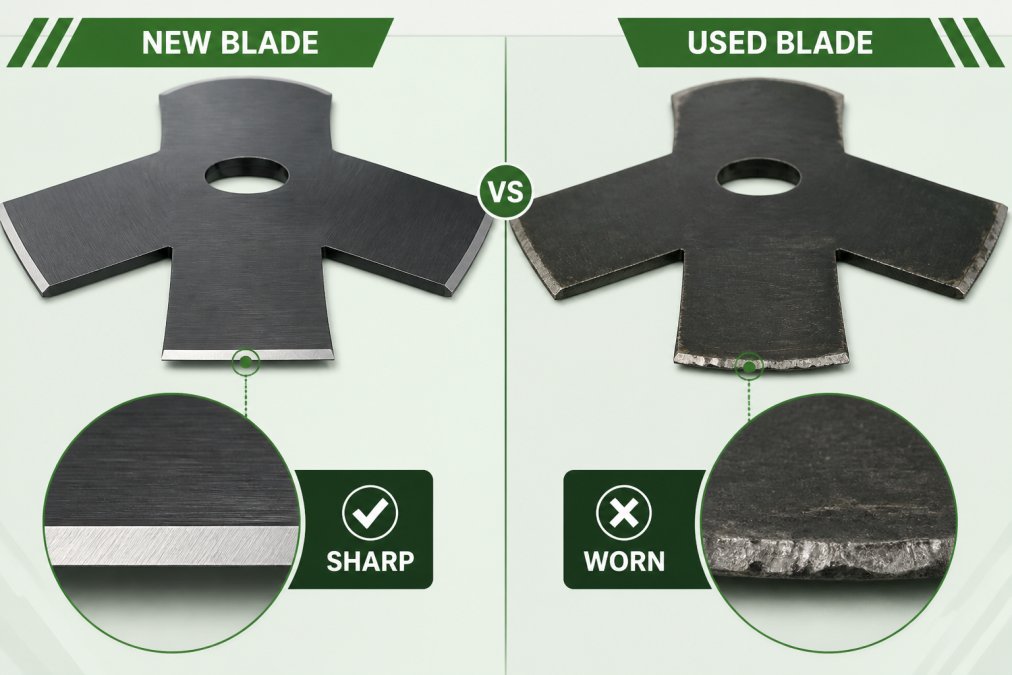
Clean, smooth cuts become slightly ragged or show minor burring. The machine may vibrate more noticeably, or the operator needs more pressure to maintain cutting speed.
A sharp blade edge reflects light as a thin line. A dull blade shows a rounded edge. Micro-chipping indicates the blade is near replacement time.
Replacement intervals depend on material type and volume. For high-volume operations, every 2-4 weeks may be necessary; for lower-volume shops, 6-8 weeks is common. Track replacements to identify your operation's pattern.
Waiting too long creates hidden costs: more operator attention, increased machine wear, and potential trimmer damage. Replacing blades slightly early prevents downstream costs.
Three-Knife Trimmer Blade Sharpening Services vs. Replacement
This decision often determines whether aftermarket blades make financial sense. Do you sharpen and reuse, or replace with new blades?
Professional sharpening restores a blade to near-original performance using precision grinding equipment. The result is a blade that cuts almost as well as new, at a fraction of replacement cost.
A blade costing a certain amount to sharpen can justify multiple sharpenings.
Turnaround time is critical. If your trimmer sits idle waiting for sharpening, downtime cost can exceed replacement cost. A fast turnaround is workable; a longer wait makes replacement a better option.
Professional sharpening combined with backup blades on hand maintains cutting performance without production delays.
In-house sharpening can be challenging. The equipment can be expensive, the skill is specialized, and many shops may lack the precision grinding capability to restore a blade correctly. Attempting sharpening in-house can result in blades that do not perform optimally.
Calculating ROI: Downtime, Tool Life, and Operational Efficiency
The real value of aftermarket three-knife trimmer blades shows up in the numbers. Here's how to calculate whether they make sense for your operation.
Calculate your actual costs:
| Cost Factor | How to Measure |
|---|---|
| Blade replacement cost | Current per-blade expense (OEM or aftermarket) |
| Sharpening cost | Per-blade professional sharpening fee |
| Downtime per replacement | Hours machine is idle × hourly production value |
| Blade lifespan | Days or linear feet before replacement needed |
| Annual blade volume | Number of blades replaced per year |
Multiply blade cost by annual volume. Add downtime costs (hours idle × production value per hour). Compare against alternative blade options.
For example, a print shop replacing blades weekly incurs certain annual costs. If aftermarket blades offer savings, that can reduce expenses. If downtime costs are significant per replacement, switching to blades requiring fewer replacements can lead to further annual savings.
Factor in machine wear: dull blades stress the drive mechanism.
Making the Right Choice for Your Shop
The decision to switch to aftermarket three-knife trimmer blades comes down to three questions: Do they cut as well as what you're using now? Will they reduce your total operational costs? Can you handle the logistics of switching suppliers?
Warranty Considerations and Machine Compatibility
Installation and Changeover Process
-
Disconnect power, Unplug the trimmer or switch off the main power supply. This is non-negotiable for safety.
-
Access the blade cartridge, Most trimmers have a cover plate or cartridge housing that holds the three knives. Remove fasteners (typically Phillips or hex-head bolts) to access the blade assembly. Some models require removing a side panel; others have a top-mounted cartridge.
-
Remove the old blade set, The three knives are usually held in place by a single cartridge or by individual mounting brackets. Lift out the old blade assembly. Note the orientation: the beveled edge faces downward (toward the material being cut). The top surface is flat or slightly curved.
-
Clean the blade housing, Use a soft brush or compressed air to remove metal shavings and debris from the blade housing. Accumulated debris can prevent proper blade seating and cause uneven cutting.
-
Install the new blade, Align the new blade cartridge or individual knives with the mounting points. The blade must sit flush against the housing. Insert fasteners and tighten in a cross pattern (like tightening car wheel lugs) to ensure even pressure. Over-tightening can crack the blade or damage the housing; hand-tight plus a quarter turn is usually correct.
-
Test the blade alignment, Manually rotate the trimmer's cutting head (if possible) to verify the blade doesn't bind or rub. Listen for any grinding sounds, which indicate misalignment.
-
Run a test cut, Make a test cut on scrap material similar to what you'll be trimming. Check for clean edges, vibration, or unusual sounds. If the cut is ragged or the machine vibrates, stop and check blade alignment.
Test Before Committing
Frequently Asked Questions
How often should I replace aftermarket three-knife trimmer blades?
Replacement frequency depends on material throughput, cutting performance demands, and blade material. High-speed steel (HSS) blades typically need replacement or sharpening every 2-4 weeks in heavy-use environments, while tungsten carbide tipped (TCT) blades can extend tool life to 6-8 weeks or longer. Monitor for ragged cuts, increased machine vibration, and reduced binding quality as signs it's time to replace. Precision sharpening services can extend intervals between replacements, reducing overall replacement frequency and operational costs.
What's the difference between HSS vs TCT trimmer blades for durability?
High-speed steel (HSS) blades offer good edge retention at lower cost but require more frequent sharpening and replacement. Tungsten carbide tipped (TCT) blades deliver superior wear-resistant performance and blade hardness, maintaining cutting edge integrity through higher material throughput. TCT blades typically last 3-4 times longer than HSS, reducing replacement frequency and machine downtime. The trade-off is higher upfront cost, making TCT more cost-effective for high-volume operations where tool life and operational efficiency directly impact profitability.
Are three-knife trimmer blade sharpening services really cheaper than buying new blades?
Sharpening services restore blades to sharp, efficient edges at a fraction of replacement cost, extending tool life. For shops with moderate-to-heavy cutting volume, precision sharpening on a regular maintenance schedule reduces total cost of ownership compared to constant replacement. However, severely damaged blades or those with metal fatigue may not be economical to sharpen. The best approach combines scheduled sharpening intervals with aftermarket replacement when blades reach end-of-life, balancing cost-effectiveness with consistent cutting performance and reduced machine wear.
Do aftermarket blades increase the risk of damaging my trimmer?
Quality aftermarket blades manufactured to OEM specifications carry minimal risk when properly installed. Poor-quality aftermarket options may have precision tolerance issues that affect blade geometry and bevel angle, potentially causing machine wear and binding quality problems. Verify that aftermarket blades match your trimmer model's exact specifications and come from reputable suppliers. Proper installation and regular maintenance schedules further reduce risk. The Cutting Edge Grinding & Supply Co. offers compatible replacement blades designed to maintain optimal performance without compromising equipment integrity.